This is the longest route we suggest, and the one that needs the most planning. Ten days, several hundred miles, and a loop that goes down through the south and comes back along the north so that you never drive the same road twice.
It is not a route for a first weekend in a motorhome. If this is your first hire, our Suffolk or Norfolk guides are a better place to start. If you have a little experience and a full ten days, this is the trip.
Book your sites before you leave. In July and August the far west fills up completely.
Why choose the West Country?
Because the variety is extraordinary. Neolithic stone circles, a Jurassic coastline, a granite moor, a sub-tropical garden and a tidal island, all on one road trip.
The distances are real, though. Abberton to Wiltshire is most of a morning, and Wiltshire to west Cornwall is another long day on top. Splitting the journey the way this route does keeps any single drive to a reasonable length.
The one thing to understand before you go is the lanes. West Devon and Cornwall have high banked lanes that are genuinely narrow, often with no verge and few passing places. Stick to the A roads with a motorhome wherever you can, and do not let a satellite navigation system talk you into a shortcut.
Day 1: Abberton to Wiltshire
The long leg, done first
Today is mostly driving, and that is deliberate. Getting the long haul out of the way on day one means the other nine days are gentle.
Allow around four hours to the Marlborough and Avebury area, plus proper breaks. Leave in the morning rather than after lunch.
If you arrive with daylight left, walk out into the Avebury stone circle. Unlike Stonehenge you can walk among these stones, and there is a village inside the circle, which takes a moment to make sense of.
There are sites around Marlborough, Devizes and Calne. The lanes in Avebury village itself are narrow and unsuitable for a long vehicle, so use the main car park and walk in.
Fill up before you leave Essex and plan one proper stop on the way. A four hour drive on day one is manageable if you break it.
Day 2: Stonehenge and Salisbury
Five thousand years before lunch
Stonehenge is twenty minutes south. The visitor centre is set back from the stones with a shuttle bus to the circle, and timed tickets are normally needed, so book in advance rather than turning up.
Salisbury is close by and makes a good afternoon. The cathedral has the tallest spire in Britain and one of the four surviving original copies of Magna Carta, kept in the Chapter House. The close around it is the finest in England.
Then head south into Dorset. The country lanes soften, the hills begin, and you get the first sense of being properly west.
Consider sites towards Blandford Forum, Wareham or the edge of the Purbecks, which sets up tomorrow well.
Book Stonehenge before you travel. Walk-up availability is limited and often gone by the middle of the day.
Day 3: Corfe Castle and the Jurassic Coast
Ruins above a gap in the hills
Corfe Castle stands in a natural gap in the Purbeck ridge, deliberately blown up in the Civil War and all the more dramatic for it. The village below is grey stone and small, and the Swanage Railway runs steam trains from the platform at the bottom of the hill.
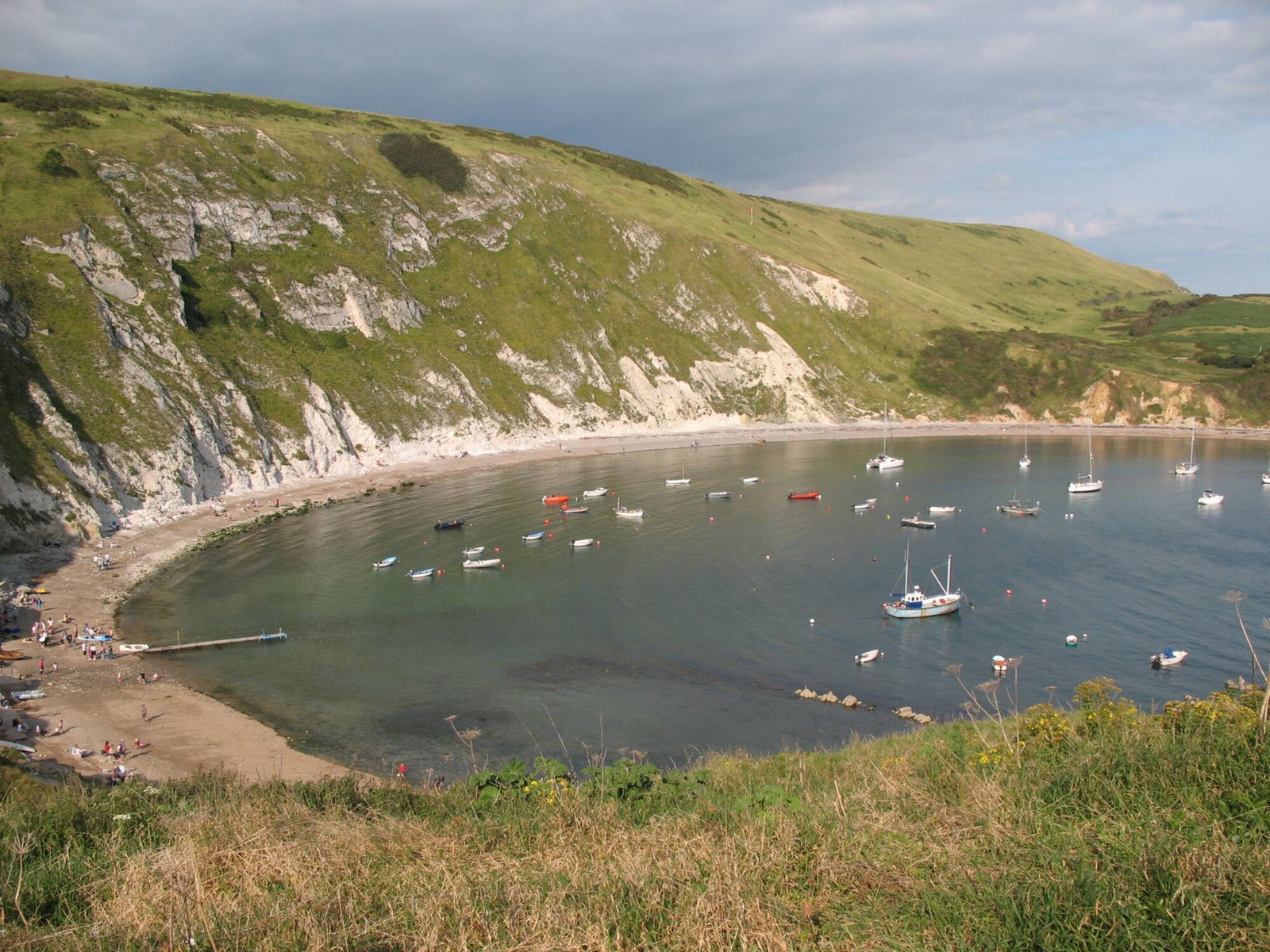
In the afternoon, head for the coast. Lulworth Cove is an almost perfect circle of water cut into the cliffs, and Durdle Door, the stone arch everybody knows, is a walk of about a mile west from the same car park. The path is steep in both directions and the steps down to the beach are steeper still.
The Lulworth estate car park takes larger vehicles, but check the current arrangements and charges before you commit to the approach road.
There are sites around Wool, West Lulworth and Wareham. This is a busy corner in season, so book early.
Parts of this coast are inside an active military firing range at Lulworth. The ranges have published access days, so check before planning a walk east of the cove.
Day 4: Weymouth, Portland and Chesil Beach
A shingle bank eighteen miles long
Weymouth has a Georgian seafront, a proper harbour and a long sandy beach, and it is an easy, unpretentious day.
South of it, the Isle of Portland is joined to the mainland by Chesil Beach, a shingle bank that runs for about eighteen miles and is one of the strangest landforms in Britain. Portland itself is bare, quarried stone, with a lighthouse at the Bill and a sense of being much further out to sea than it really is.
In the afternoon, work west along the coast towards Lyme Regis.
Sites around Abbotsbury, Bridport and Charmouth suit this stretch. Charmouth puts you on the fossil beach for tomorrow morning.
The climb onto Portland and the descent back off it are both steep. Use a low gear rather than the brakes on the way down.
Day 5: Lyme Regis and into Devon
Fossils and the Cobb
Lyme Regis is where fossil hunting became a science, largely through Mary Anning, who found her first complete ichthyosaur here as a girl. The beach between Lyme and Charmouth still produces ammonites after a storm, and the local museums and guided fossil walks will show you what to look for.
The Cobb, the curved stone harbour wall, is the town’s other landmark. Walk out along it if the sea is calm and the stones are dry.
Lyme is built on a steep hill with narrow streets. Park at the top and walk down, and be ready for the climb back.
In the afternoon, carry on west into Devon.
Consider sites around Seaton, Sidmouth or towards Exeter depending on how far you want to be tomorrow morning.
Collect fossils from the loose shingle on the beach, never from the cliff face. The cliffs here are actively unstable.
Day 6: Dartmoor
Granite, ponies and weather
Dartmoor is the largest open space in southern England and it feels it. Bare granite tors, open grazing, and weather that arrives without much warning.
Haytor is the easiest of the tors to reach, with a car park close to the rocks and a short climb to the top. Widecombe-in-the-Moor sits in a valley with a church tower out of all proportion to the village. Princetown, high on the moor, has a visitor centre and the prison.
Stick to the B roads across the moor. The unclassified lanes are narrow, walled and used by livestock, and they are not the place to meet a tractor in a motorhome.
There are sites on the edges of the moor around Moretonhampstead, Ashburton and Tavistock. High pitches are exposed, so check the forecast.
Livestock roam free on the moor and ponies stand in the road at night. Drive slowly after dark, or better, do not.
Day 7: Into Cornwall
Fowey, Eden and the south coast
Cross the Tamar and the character changes again. Head for Fowey, a steep-sided harbour town on a deep estuary, with a passenger ferry across to Polruan on the far bank.
Fowey itself is extremely tight for a large vehicle. Use the park and ride above the town and walk down, which is the advice the town itself gives.
Nearby, the Eden Project has built two enormous biomes in a worked out clay pit, one of them rainforest. The Lost Gardens of Heligan, a few miles away, are the quieter choice if you would rather have a long walk than a big attraction. Either fills an afternoon comfortably.
There is a good choice of sites around St Austell, Mevagissey and Lostwithiel. Many Cornish sites are on narrow approach lanes, so read the directions the site gives rather than following a postcode.
Follow the site’s own written directions in Cornwall. Satellite navigation will happily route a seven metre vehicle down a lane built for a cart.
Day 8: The far west
St Michael’s Mount, Penzance and St Ives
The far west of Cornwall is worth the whole journey. St Michael’s Mount rises out of the bay at Marazion and is reached on foot across a granite causeway at low tide, or by boat when the tide is in. Check both the tide and the opening arrangements before you go.
Penzance has a handsome promenade and an art deco sea water lido. Beyond it, the Penwith peninsula runs out to Land’s End past small coves and the open air Minack Theatre, cut into the cliff above Porthcurno.
St Ives, on the north side, has the light that brought the painters, a Tate gallery and the Barbara Hepworth museum and sculpture garden. It is also close to impossible to park a motorhome in. Use the park and ride and the branch line train, and check the current arrangements before you set off, as they have changed in recent years.
There are many sites around Hayle, Sennen and the Penwith peninsula. This is the busiest corner of Cornwall, so book well in advance.
Do not attempt to park in St Ives itself. Every year somebody tries.
Day 9: The north coast and Exmoor
Turning for home the long way
Start the journey back along the north coast, which is a different country from the south: higher cliffs, bigger surf and fewer trees.
Tintagel has the ruins of a cliff top castle, now linked by a footbridge across the gap to the headland. Further on, Clovelly is a privately owned village of cobbled steps running down to a harbour, with no cars at all and an admission charge at the visitor centre.
Then Exmoor, and the twin towns of Lynton and Lynmouth, one on the cliff and one at the bottom, joined by a water-powered cliff railway that has been running since the nineteenth century.
A warning worth taking seriously: Porlock Hill, on the A39 east of Lynmouth, is one of the steepest main roads in England at around one in four with hairpins. There is a toll road alternative that is longer, gentler and well worth the money in a motorhome.
Consider sites around Lynton, Porlock and Minehead. Many are on steep ground, so ask about the approach when you book.
Take the Porlock toll road. It exists precisely because the hill defeats heavy vehicles.
Day 10: Somerset and the journey home
The last long drive
From west Somerset the run home to Abberton is around four hours, so this is a day to start early and stop once properly rather than three times briefly.
If you want one last stop, Cheddar Gorge and Glastonbury are both close to the route east. The gorge road is narrow with rock on both sides and parking is limited, so judge it on the day.
Then east, with plenty of time for refuelling and for the return arrangements agreed at collection.
If you can stretch the hire to eleven days, do. Splitting this last drive with a night in Wiltshire turns a tiring day into an easy one.
Your return time is agreed when you hire your vehicle. On a ten day trip this far west, confirm the final morning plan a day or two before.
Make the most of ten days
A few simple things matter more on a long route than a short one:
- Book your overnight stops in advance. Popular sites fill quickly during school holidays and summer weekends.
- Check access before you travel. Some car parks have height barriers, narrow approaches or vehicle length limits. Never assume a space is suitable for your motorhome.
- Keep your days flexible. The suggested stops are options, not a checklist. There is no need to see everything.
- Travel light and plan your supplies. Stock up on essentials before leaving, then enjoy discovering local shops and food along the way.
- Respect the countryside. Follow local parking rules, take your rubbish with you and leave overnight stops as you found them.
- Check opening times and seasonal services. Ferries, boat hire, attractions and campsite facilities may not operate all year.
Ready for the West Country?
Ten days sounds like a lot until you are standing on the causeway at Marazion working out whether you have time to go back for the camera.
Plan the drives, book the sites, and then let the rest of it happen at whatever speed it wants to.
PWS Go, your adventure starts here.
Suggested itinerary only. Driving times, routes, campsite availability and attraction opening arrangements vary. Please confirm suitability for your hired vehicle and make bookings directly with the relevant providers before departure.